Your voice matters. Have your say on how we administer Australia’s national environmental protection laws as we strive for continuous improvement. Complete this survey to help shape our priorities and inform how we provide our services and conduct our activities.
The survey will be open until 11:59pm AEST Thursday, 30 September 2026. If you have any questions, please contact: surveyhelp@nationalepa.gov.au
Emissions standards exist as part of a national framework to reduce air pollution and improve air quality. This is important as it impacts the environment and the quality of the air we breathe. Air quality can have temporary and lasting impacts on our health.
Customs brokers play an important role in helping improve Australia’s air quality. They ensure imported Emissions-Controlled Products (ECPs) meet the requirements of the Product Emissions Standards Act 2017 (the Act) and the Product Emissions Standards Rules 2017 (the Rules) by declaring the ECPs in the Integrated Cargo System (ICS).
Emissions controlled products
The Product Emissions Standards set limits on harmful emissions from products defined as:
new, complete non-road spark-ignition engines with maximum engine power of 19 kilowatts or less, and
new, complete spark-ignition propulsion marine engines of any power capacity.
Examples of products that are ECPs include but are not limited to:
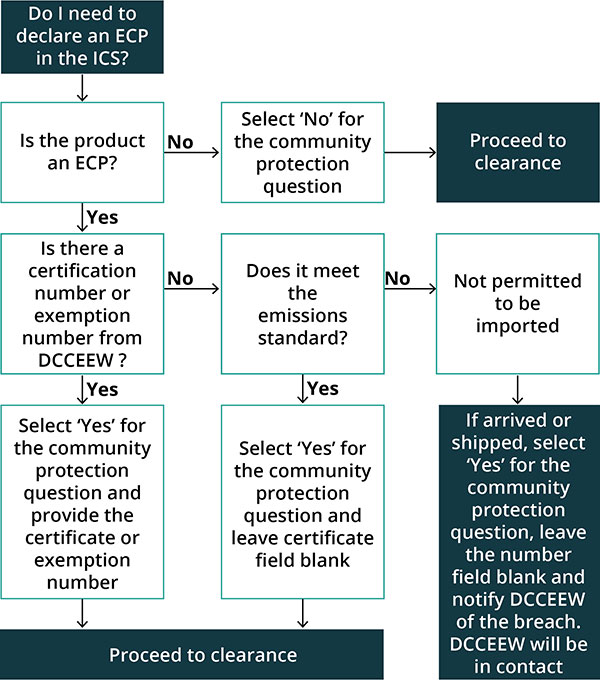
The following flow chart assists you in navigating the ICS when declaring ECPs.
Image
The flow chart has 11 boxes including 3 decision points. Here the flow chart is described as a list in which the possible next steps are listed beneath each box label.
Do I need to declare an ECP in the ICS?
Is the product an ECP?
If No, go to 3
If Yes, go to 5
Select ‘No’ for the community protection question
Proceed to clearance
Is there a certification number or exemption number from DCCEEW?
If No, go to 6
If Yes, go to 8
Does it meet the emissions standard?
If No, go to 7
If Yes, go to 10
Not permitted to be imported
If arrived or shipped, select ‘Yes’ for the community protection question, leave the certificate field blank and notify DCCEEW of the breach.
Select ‘Yes’ for the community protection question and provide the certificate or exemption number
Go to 11
Select ‘Yes’ for the community protection question and leave certificate field blank
Proceed to clearance.
Customs brokers checklist
The following steps will support you and your clients in ensuring only compliant products are reaching Australian shores.
Remind your client that providing missing, incomplete, or incorrect information can have serious consequences. These include customs delays, the seizure of goods or significant financial penalties.
Your client will need to provide some key details for each type of ECP they plan to import. This is to ensure the accuracy and compliance of import declarations. At a minimum, they need to supply:
a brief description of the ECP
the quantity of ECPs being imported or supplied
the emissions certification number or the exemption number for each product.
This information will ensure correct declarations and help avoid processing delays.
Your client should provide assurance they are satisfied the ECP meets the requirements of the Act. This includes:
verifying each ECP is either Australian certified or holds the appropriate foreign certification of conformity
ensuring each ECP is correctly labelled in accordance with Part 6 of the Rules.
Having this confirmation supports compliance. It also helps prevent potential issues at the border or with regulators in future. Learn more about Product Emissions Standards Certification.
Respond to the CPQ carefully. If you must submit an import declaration without full details, answer the CPQs accurately. Flag any uncertainties to customs authorities and contact us to discuss how to proceed.
Whenever possible, take advantage of available tools and networks to verify important details. This might include:
checking import databases
reviewing product listings
reaching out to industry contacts
consulting with government authorities.
This can help ensure accuracy and simplify the import process by catching any potential issues early. If you are not confident that the products are compliant, contact the Product Emissions Standards Team.
Under specific circumstances some ECPs qualify for an exemption from the Act. Exemption categories are detailed in Part 5 of the Rules. Encourage your clients to check and lodge an application for exemption.
If your client is uncooperative, or the goods appear non-compliant, you can choose not to proceed with the customs declaration and avoid legal risks.
Customs brokers obligations
All information entered in an Import Declaration within the ICS (including the response to the CPQ) is legally considered to be a statement made to a Customs Officer.
Providing false or misleading information in an Import Declaration is an offence under the Customs Act 1901.
Failure to comply with the requirements of the Product Emissions Standards Act 2017 in relation to the importation of ECPs may result in significant financial penalties and/or legal action.
Importers and their representatives must ensure all declarations are accurate and complete.
Our role
We enforce the Product Emissions Standards Act 2017, which sets emission standards for certain products imported into, manufactured, or supplied in Australia.
We administer the Product Emissions Standards Rules 2017, which set technical requirements to ensure the objectives of the Act are met.
We support the regulated community to understand their obligations under relevant legislation.
We process applications for Australian certification and applications for exemptions.
We also collect fees and charges and undertake activities to ensure compliance with the emissions standards. To learn more visit Cost Recovery – Charges and Fees.
Contact us
For more information on how the product emissions standards may apply: