Your voice matters. Have your say on how we administer Australia’s national environmental protection laws as we strive for continuous improvement. Complete this survey to help shape our priorities and inform how we provide our services and conduct our activities.
The survey will be open until 11:59pm AEST Wednesday, 30 September 2026. If you have any questions, please contact: surveyhelp@nationalepa.gov.au
The department assesses your application against the requirements of the Sea Dumping Act and London Protocol.
Environment Impact Assessment requirements
Sea dumping permit applications must be assessed against Annex 2 of the 1996 Protocol to the Convention on the Prevention of Marine Pollution by Dumping of Wastes and Other Matter, 1972 (the London Protocol). There are separate considerations for artificial reef applications.
Annex 2 of the London Protocol details the comprehensive Environmental Impact Assessment (EIA) requirements that the Sea Dumping Act must fulfill. The EIA framework is internationally recognised as the best approach to assess and minimise pollution impacts from dumping on the marine environment.
Assessment considerations include:
alternative disposal methods to dumping
opportunities to re-use, recycle, remove, or treat hazardous components, or dispose of the material on land
a full description of the site where the material would be dumped
the potential impacts to human health and the environment.
The London Protocol bans waste from being dumped if it is not possible to fully:
describe the waste
understand what risk it may pose to the environment and human health.
London Protocol and Australian guidance documents support the EIA requirements of Annex 2 of the London Protocol. These are used to help inform the minister’s (or delegate’s) decision of whether or not a permit should be granted.
Any updates to the London Protocol’s EIA associated guidance will be reflected in our assessment process. This ensures Australia continues to meet our international obligations. It allows us to take an accurate approach to permit assessment, informed by current and reputable scientific guidance.
We encourage you to organise a pre-application meeting with the department to discuss EIA requirements. Meetings can be arranged by sending an email to the Sea Dumping section, via seadumping@dcceew.gov.au.
Application assessment
The progression of your permit application depends on the submission of adequate information to the department for assessment.
During the assessment, we may:
request a review of your application by an independent expert
Under the Sea Dumping Act, the minister (or delegate) may require:
the submission of additional information where there are gaps in the application
an agreement to undertake research, analysis or monitoring under section 18(4) or 19(9) before a permit may be granted (see Research and monitoring programs on this page).
The minister (or delegate) may determine that additional research, analysis or monitoring is required to assess your sea dumping permit application or be undertaken if a permit is granted.
Under sections 18(4) and 19(9) of the Sea Dumping Act, the minister can require an applicant to enter an agreement to undertake the required research, analysis or monitoring actions. This may stop the clock on the assessment of your application.
Agreements may include:
the applicant carrying out the research, analysis or monitoring at their own expense
the applicant reimbursing the Australian Government for undertaking or supervising the required research or analysis.
We will discuss any requirements with you during the assessment of your application.
Stopping the assessment clock on an application
The Sea Dumping Act requires the minister (or delegate) to decide whether to grant a permit within 90 days of an application being ‘duly made’.
An application is duly made when:
all aspects of the application have been addressed
application fees have been paid within the required time frame (30 days after submission).
At any time within the first 60 days of the assessment timeframe, the minister can seek more information from you. This assists in making a decision on your application. If further information is requested, this stops the statutory assessment clock.
The 90-day timeframe for a decision to grant a permit does not begin until all the required information is received. We may repeat these requests until we have adequate information for the minister (or delegate) to make an informed decision on whether to grant the permit.
Complex applications may take 12–18 months to resolve. The timeframe is dependent on you providing the requested information to the satisfaction of the minister (or delegate).
Image
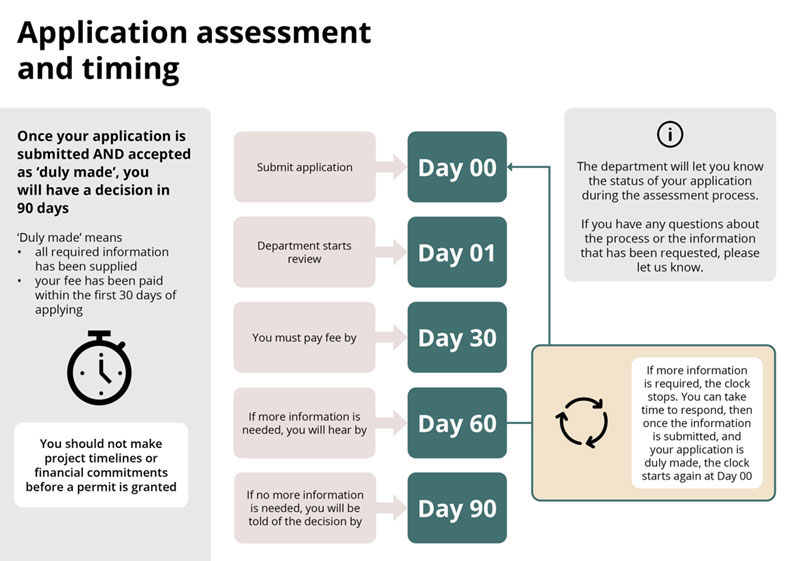
Once your application is submitted and accepted as ‘duly made’, you will have a decision in 90 days.
‘Duly made’ means:
all required information has been supplied
your fee has been paid within the first 30 days of applying.
You should not make project timelines of financial commitments before a permit is granted.
The day you submit the application is day 0.
We start our review on day 1.
You must pay the fee by day 30.
If more information is needed, you will hear by day 60. If no more information is needed, you will be told of the decision by day 90.
Between day 0 and day 60, if more information is required, the clock stops. You can take time to respond, then once the information is submitted, and your application is duly made, the clock starts again at day 0.
We will let you know the status of your application during the assessment process.
If you have any questions about the process or the information that has been requested, please let us know.
Grant of a permit
Submitting a sea dumping application does not guarantee it will be granted. We assess all applications on a case-by-case basis, and in accordance with the Sea Dumping Act.
When planning your project make sure to:
allow enough time for us to assess and process your application
account for the possibility that the clock may be stopped on your assessment if the minister requires more information from you
carefully consider contractual arrangements to avoid unexpected costs if a permit is not granted or is delayed.
If your proposed activity needs to be assessed under the EPBC Act, timeframes may be extended.
Once we assess your application against the EIA requirements, we make a recommendation to the minister (or their delegate) about whether your activity should be granted a sea dumping permit. The minister (or their delegate) may impose conditions on any permits they grant.
As described within Annex 2 of the London Protocol, conditions may relate to the below or other project-specific conditions:
steps that must be taken to prevent environmental impacts
a pollution prevention plan, which may include research and monitoring requirements
exclusion zones around environmental and cultural resources