Dumping and abandonment of offshore oil and gas platforms and structures at sea
Body
Closing soon. Don't miss out!
Your voice matters. Have your say on how we administer Australia’s national environmental protection laws as we strive for continuous improvement. Complete this survey to help shape our priorities and inform how we provide our services and conduct our activities.
The survey will be open until 11:59pm AEST Wednesday, 30 September 2026. If you have any questions, please contact: surveyhelp@nationalepa.gov.au
The Environment Protection (Sea Dumping) Act 1981 (Sea Dumping Act) regulates the dumping or abandonment of platforms or other man-made structures in Australian waters. It also regulates these actions from Australian vessels in any part of the sea. You may need a sea dumping permit to abandon, move or modify for disposal structures or materials from the offshore oil and gas industry.
Activities carried out in Australian waters during the following phases of oil and gas production do not require a permit:
exploration
exploitation
offshore processing.
During other phases, activities that are considered to be dumping or abandonment require a sea dumping permit.
Well infrastructure below the mudline, including the well bore and any plugs, is considered to have been placed for a purpose. They do not need a sea dumping permit.
Oil and gas activities that may need a sea dumping permit
If you own or operate oil and gas infrastructure, Australian law requires you to remove it from the sea when oil and gas operations end. This achieves 3 outcomes:
Australia upholds its international obligations
the marine environment is protected
risks are minimised for other users of the sea.
In limited circumstances, you may apply for a sea dumping permit to leave certain types of infrastructure in the sea. Applicants must consider waste management options when preparing an application, in line with paragraph 5 of Annex 2 to the London Protocol.
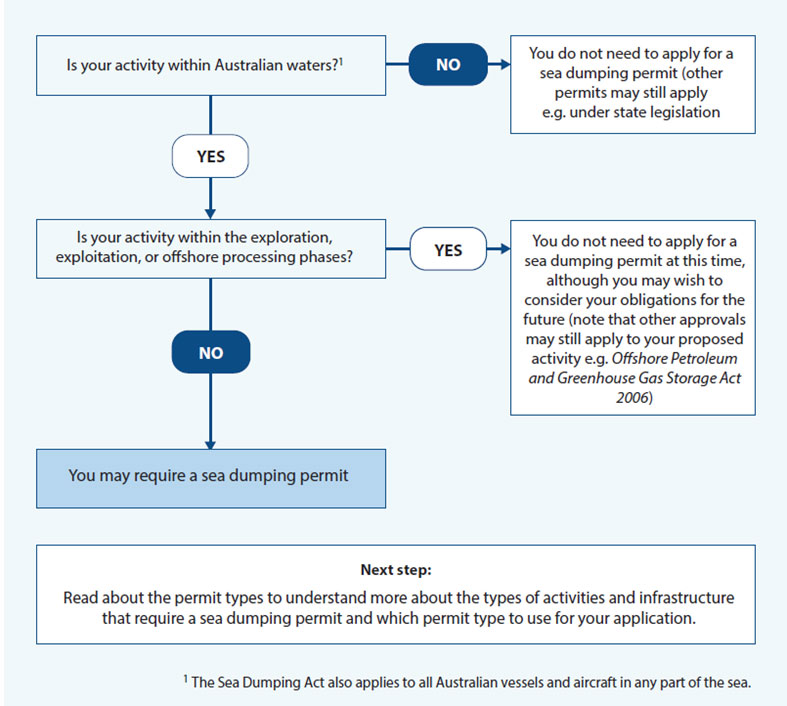
Figure 1 shows a decision flowchart of the different permit types. Activities that may need a sea dumping permit include:
dumping (moving the item from its current location and disposing of it in Australian waters) of any oil and gas infrastructure
abandonment in-situ of most oil and gas infrastructure within Australian waters, in the location where it originally served its purpose
The Minister (or delegate) considers each application for a permit separately. They review the proposal to decide whether the activity is considered sea dumping under the London Protocol and the Sea Dumping Act. More information is available for how to prepare a sea dumping permit application and how applications are assessed.
Image
Figure 1. Decision flowchart and description of sea dumping permit types for oil and gas activities.
Is your activity in Australian waters?
If NO, you do not need to apply for a sea dumping permit (other permits may still apply e.g., under state legislation).
If YES, then question: Is your activity within the exploration, exploitation, or offshore processing phases?
If YES, you do not need to apply for a sea dumping permit at this time, although you may wish to consider your obligations for the future (note that other approvals may still apply to your proposed activity e.g., Offshore Petroleum and Greenhouse Gas Storage Act 2006).
If NO, you may require a sea dumping permit.
Next step: Read about the permit types to understand more about the types of activities and infrastructure that require a sea dumping permit, and which permit type to use for your application.
what to consider when you are preparing an application to leave infrastructure in the sea
types of infrastructure that cannot be left in the sea
types of infrastructure that may be assessed under relevant legislation to determine whether it may be left in the sea in limited circumstances.
Offshore decommissioning should be planned with this guidance in mind. If you plan to leave infrastructure in the sea, the table below will help you choose the correct permit type. The infrastructure listed sits within the guidance category of ‘may be assessed to determine whether it may be left in the sea in limited circumstances’ (guidance table 3). If infrastructure is not listed, it may sit within the category of ‘cannot be left in the sea’ (guidance table 2).
Types of sea dumping permits
Type of permit
Activity requiring a permit
Dumping permit
Required when offshore activities involve deliberate moving, modifying or disposing of infrastructure, or disposing of waste or other matter from vessels, platforms, or other man-made structures at sea.
Examples include, but are not limited to:
pipelines or cables that have been moved, modified, or augmented in any way
items or structures fixed to the seabed that have been moved, modified or augmented, including:
platforms
jackets and foundations
inter/intra field pipelines
well heads
other oil and gas sub-sea components
gravity bases and mattresses
piles and skirts
fixed anchors or mooring blocks
pipeline stabilisers
anchor chains
additional matter added during abandonment (such as grout bags or rock protection).
Abandonment permit
Required when leaving infrastructure where it originally served its purpose, including platforms or other man-made structures at sea.
Examples include, but are not limited to:
items or structures fixed to the seabed that have not been moved, modified or augmented, including:
platforms
jackets and foundations
inter/intra field pipelines
well heads
other oil and gas sub-sea components
gravity bases and mattresses
piles and skirts
fixed anchors or mooring blocks
pipeline stabilisers
anchor chains.
Artificial reef permit
Required when incorporating oil and gas infrastructure into an artificial reef in Australian waters.
Activities exempt from sea dumping permit requirements
You may not need a sea dumping permit if you plan to abandon an export pipeline or cable that will not be moved, modified, or augmented.